The Calm Reset Bundle Workbook is Now Available for the Launch Price !!

Why Do I Feel Overwhelmed So Easily?
If you keep asking, “why do I feel overwhelmed so easily?” this gentle guide explains common reasons behind overwhelm, practical calming steps, journaling prompts, and simple self-care tools to support mental clarity.
MIND YOUR MIND
Mind Your Co. Editorial Team
5/20/2026


Why Do I Feel Overwhelmed So Easily?
Have you ever looked at a simple task, replying to a message, folding laundry, opening your laptop, making one decision, and felt like it was suddenly too much? Not because the task was impossible, but because your mind already felt full.
If you have been asking yourself, “why do I feel overwhelmed so easily?”, the answer is usually not that you are weak, lazy, or incapable. Overwhelm often happens when your mind and body are carrying more stress, input, emotion, responsibility, or uncertainty than they have space to process. Stress can affect both the mind and body, including worry, tension, headaches or body pain, sleep trouble, and feeling uneasy or overloaded.
Sometimes overwhelm is about the current moment. Other times, it is about everything that has been building quietly underneath it.
This guide will help you understand why overwhelm can happen so easily, what may be contributing to it, and how to respond with simple, practical support instead of self-criticism.
For a complete foundation, visit our Mental Wellness & Gentle Self-Care Guide.
Understanding the Struggle
Overwhelm can feel different for everyone.
For some people, it feels like a racing mind. For others, it feels like heaviness, shutdown, irritability, tiredness, or emotional sensitivity. You may know what needs to be done, but still feel unable to begin.
You may notice:
Small tasks feel unusually heavy
Your thoughts jump from one concern to another
You feel tense, restless, or emotionally full
You avoid decisions because everything feels urgent
You feel guilty for needing rest
You struggle to focus
You want quiet, but your mind will not slow down
You feel like you are behind even when you are trying
Stress can show up emotionally, physically, and behaviorally. Mayo Clinic lists common stress effects such as headache, muscle tension, chest pain, fatigue, sleep problems, anxiety, restlessness, lack of motivation or focus, irritability, overeating or undereating, and withdrawing from others.
That matters because overwhelm is not only “in your head.” Your body may also be responding to pressure. At Mind Your Co., we describe overwhelm as the moment when your inner capacity feels smaller than what life is asking from you. That does not mean you are failing, it may mean you need support, space, rest, structure, or a smaller next step.
Why You May Feel Overwhelmed So Easily
There is rarely one single reason. Overwhelm usually comes from a combination of mental, emotional, physical, and environmental pressure.
Here are some common reasons it may feel like overwhelm happens quickly.
1. Your Mind Is Carrying Too Many Open Loops
An “open loop” is anything your mind keeps trying to remember, solve, avoid, prepare for, or emotionally process.
Examples:
A message you need to answer
A bill you need to check
A conversation that still bothers you
A task you keep delaying
A decision you have not made
A feeling you have not had time to process
A goal that feels too big
Even if you are not actively thinking about each one, your mind may still be holding them in the background.
That can make a small task feel bigger than it really is, a simple email may not feel like one email. It may feel like one more thing added to a long invisible list.
Mind Your Co. reflection prompt:
“What is my mind trying to hold that I could write down instead?”
2. Your Stress Has Not Had Enough Recovery Time
Stress is not always harmful in short bursts. It can help you respond to pressure, meet deadlines, or deal with challenges.
But when stress continues without enough recovery, your system can begin to feel overloaded.
The American Psychological Association notes that the longer stress lasts, the more difficult it can become for both mind and body, with people potentially feeling fatigued, unable to concentrate, or irritable.
If you have been pushing through for weeks or months, your capacity may be lower than usual. That means something small can become the final drop in an already full cup.
You may think:
“Why am I reacting like this over something so small?”
But it may not be about that one small thing, it may be about everything that came before it.
3. You Are Receiving Too Much Input
Modern life asks the mind to process a lot.
Messages. Notifications. News. Social media. Work updates. Family responsibilities. Financial pressure. Personal goals. Health information. Comparison. Noise.
Even helpful information can become too much when there is no pause between inputs.
The CDC recommends taking breaks from news and social media as one healthy way to cope with stress, because constant information about negative events can feel upsetting. The CDC also recommends unwinding, journaling, spending time outdoors, deep breathing, stretching, meditating, and practicing gratitude.
When your brain has no quiet space, it becomes harder to know what actually needs your attention. A gentle first step is not always doing more, sometimes it is reducing what is coming in.
4. Your Thoughts Are Moving Faster Than Your Next Step
Overwhelm often grows when your mind jumps too far ahead.
Instead of focusing on the next action, it begins scanning every possible problem:
What if this goes wrong?
What if I disappoint someone?
What if I cannot finish everything?
What if I make the wrong decision?
What if I am already behind?
This can lead to racing thoughts, decision fatigue, and emotional shutdown.
For support with this, read 3 Ways to Calm Your Racing Mind, simple ways to calm racing thoughts.
The goal is not to force your thoughts to disappear. The goal is to slow the moment down enough to choose one next step.
5. Your Body May Be Asking for Basic Care
Sometimes overwhelm is emotional.
Sometimes it is physical.
You may feel mentally overloaded because your body needs something simple:
Sleep
Food
Water
Movement
Rest
A break from screens
Fresh air
Less caffeine
A calmer environment
The World Health Organization notes that when stressed, people may find it difficult to concentrate and may experience headaches, body pains, upset stomach, or sleep trouble.
This is why Mind Your Co. self-care begins gently.
Before asking, “What is wrong with me?” try asking:
“What basic support does my body need right now?”
6. You May Be Emotionally Full
Overwhelm does not always come from tasks.
Sometimes it comes from feelings.
You may be carrying:
Grief
Disappointment
Uncertainty
Anger
Guilt
Pressure
Fear
Loneliness
Resentment
Unspoken needs
When emotions do not have space to move, they can make everyday life feel heavier. That is where journaling can help, you do not have to write pages. You can begin with one sentence:
“The feeling I have not made space for is…”
For more support, explore the Mind Your Mind: Stress, Overwhelm & Mental Clarity page.
What to Do When You Feel Overwhelmed Easily
The goal is not to fix your whole life in one sitting. The goal is to reduce pressure, create clarity, and give your nervous system one small signal of safety.
Here are practical steps you can use.
1. Name the Overwhelm Without Judging It
Start with a simple sentence:
“I feel overwhelmed right now.”
That may seem small, but naming the experience can create space between you and the feeling.
Then add:
“This feeling is information, not a personal failure.”
You are not trying to shame yourself into action. You are trying to understand what your mind and body are telling you.
2. Write Down Every Open Loop
Take a blank page and write down everything your mind is holding.
Do not organize it yet.
Write:
Tasks
Worries
Decisions
Feelings
Reminders
Questions
Responsibilities
This is not your to-do list. It is a mental unload. Once it is on paper, your mind does not have to hold it all at once.
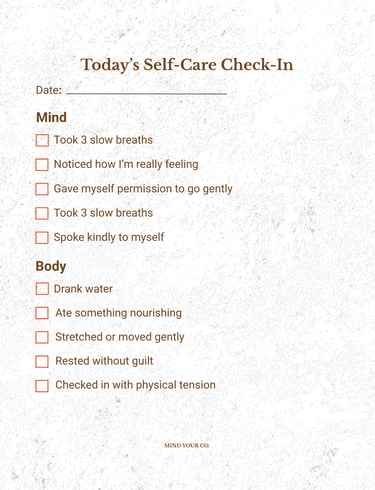
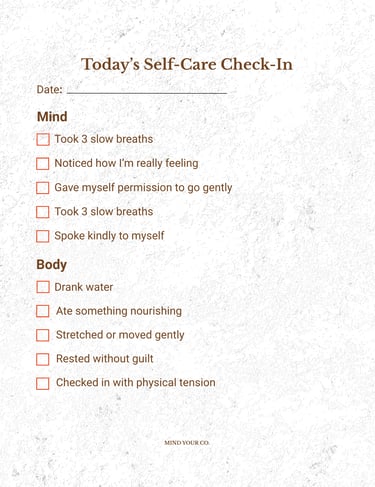
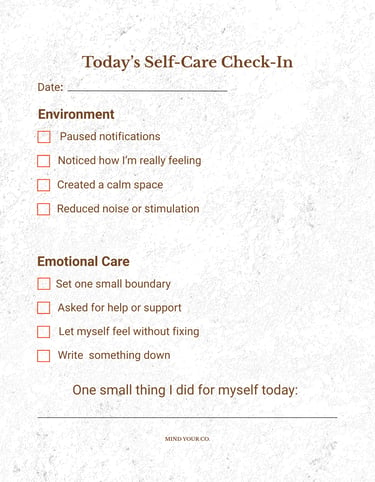
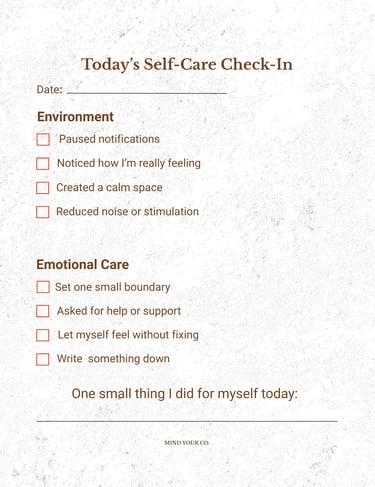
If you need a simple place to begin, download the Gentle Self-Guided Checklist and use it as a low-pressure reset when your mind feels full.
3. Choose One “Next Right Step”
Overwhelm often makes everything feel equally urgent.
Instead of asking, “How do I fix all of this?” ask:
“What is the next small step that would reduce pressure by 1%?”
Examples:
Drink water
Reply to one message
Clear one surface
Write one sentence
Step outside for two minutes
Choose tomorrow’s first task
Put one appointment in the calendar
Take three slow breaths
Small does not mean meaningless.
Small is often what makes action possible.
4. Use a Grounding Practice
Grounding helps bring your attention back to the present moment.
Try this:
Name 5 things you can see
Name 4 things you can feel
Name 3 things you can hear
Name 2 things you can smell
Name 1 thing you can do next
Meditation and mindfulness practices have been studied for stress and other health-related concerns, though evidence varies by condition and person. NCCIH notes that meditation is generally considered safe for healthy people, while people with physical or mental health conditions should speak with a healthcare provider before beginning some practices.
For related support, read 5 Ways to Feel Grounded When Everything Feels Heavy these are gentle grounding practices for emotionally heavy days.
5. Reduce Input Before Increasing Output
If your mind feels overwhelmed, adding more productivity may not help.
Before doing more, try reducing what is coming in.
For 10 minutes:
Turn off notifications
Close extra tabs
Put your phone in another room
Lower background noise
Step away from social media
Clear one small area
Then ask:
“What feels clearer now?”
This is not about avoiding life. It is about giving your mind room to process what is already there.
6. Create a “Low-Energy Version” of the Task
When something feels too big, make it smaller.
Instead of:
“Clean the whole room.”
Try:
“Clear the top of the desk.”
Instead of:
“Journal about everything I feel.”
Try:
“Write one honest sentence.”
Instead of:
“Fix my routine.”
Try:
“Choose one thing to do before bed.”
This is a key Mind Your Co. principle:
The best self-care tool is the one you can actually use on a hard day.
7. Ask Whether You Need Rest, Support, or Structure
When you feel overwhelmed easily, ask which of these you need most:
Rest
You are tired and need recovery.
Support
You need help, conversation, professional care, or emotional connection.
Structure
You need a list, plan, routine, reminder, or next step.
Different overwhelm needs different care.
If you need rest, a productivity list may feel harsh.
If you need structure, vague encouragement may not be enough.
If you need support, trying to handle everything alone may deepen the heaviness.
What We Noticed While Creating This Resource
While creating this resource for Mind Your Co., we considered one important question:
What does overwhelm feel like for someone who already knows they need self-care, but does not have the energy for a complicated routine?
That question shaped the article.
A generic wellness blog might say:
“Take care of yourself.”
But Mind Your Co. asks:
“What kind of self-care still feels possible when your mind is already full?”
That is why this article focuses on:
One-sentence journaling
Small next steps
Low-energy versions of tasks
Gentle grounding
Reducing input
Checklists that do not feel demanding
Supportive language instead of pressure
When someone feels overwhelmed, even a beautiful self-care routine can feel like another obligation. The workaround is to make the practice smaller, softer, and more realistic.
How This Resource Was Created
This article was created as part of the Mind Your Mind content cluster, which focuses on stress, overwhelm, racing thoughts, emotional regulation, grounding, anxiety-adjacent self-care, and journaling support.
The goal was not to write a broad article about stress.
The goal was to answer a specific question many people quietly ask:
“Why do I feel overwhelmed so easily?”
To create this resource, we shaped the article around three types of support:
Emotional validation — helping the reader feel seen without shame.
Educational clarity — explaining stress and overwhelm in simple, non-clinical language.
Practical action — giving small steps the reader can actually use today.
This article also connects back to the larger Mind Your Co. ecosystem, including the Mental Wellness & Gentle Self-Care Guide, the Mind Your Mind category pillar page, the Gentle Self-Guided Checklist, and the Mind Your Co. guided wellness journals.
What We Tested or Considered
When building this article, we considered whether certain advice might feel too heavy for someone already overwhelmed.
For example, a long journaling exercise may be helpful on a calm day, but it may feel impossible on a difficult day.
So the workaround is:
Use one-sentence prompts instead of full-page reflection.
We also considered whether telling readers to “make a plan” could feel too demanding.
So the workaround is:
Start with a mental unload before creating a to-do list.
And we considered whether grounding practices might feel too abstract.
So the workaround is:
Use sensory grounding, something the reader can see, feel, hear, smell, or do immediately.
This is the Mind Your Co. difference: the advice has to work in real life, not only in an ideal routine.
Gentle Journaling Prompts for Overwhelm
Use these when your mind feels full:
“Right now, I feel overwhelmed because…”
“The thought that keeps repeating is…”
“One thing I can take off my mind by writing down is…”
“The smallest next step I can take is…”
“What I need most right now is…”
“One thing I can pause until later is…”
“My low-energy version of this task is…”
“Today, I do not have to carry…”
“A gentle reminder I need is…”
“After this moment, I can choose…”
Explore the Mind Your Co. guided wellness journals for daily check-ins, gentle prompts, and reflection pages designed to support mental clarity.
When Overwhelm May Need More Support
Self-care can be helpful, but it does not have to carry everything.
If overwhelm is ongoing, intense, affecting your ability to function, or connected to persistent anxiety, sadness, panic, sleep problems, or feeling unsafe, it may be time to speak with a licensed professional or healthcare provider.
NIMH recommends seeking professional help when severe or distressing symptoms last two weeks or more, including difficulty sleeping, appetite or weight changes, difficulty getting out of bed because of mood, trouble concentrating, loss of interest, inability to complete usual tasks, or persistent irritability, frustration, or restlessness.
You deserve support that matches the weight of what you are carrying.
Encouragement
If you feel overwhelmed easily, please do not turn that into another reason to criticize yourself.
Your overwhelm may be telling you something important.
Maybe you have been carrying too much without enough recovery. Maybe your mind needs fewer inputs. Maybe your body needs rest. Maybe your emotions need space. Maybe your next step needs to be smaller than you thought.
You do not have to solve everything today.
Start with one breath.
One sentence.
One small step.
One gentle reset.
That still counts.
If this article helped you understand your overwhelm, continue with these next steps:
Visit the Mental Wellness & Gentle Self-Care Guide for a complete starting point.
Explore the Mind Your Mind: Stress, Overwhelm & Mental Clarity category page.
Read Why Everything Feels Like Too Much Lately for deeper support.
Try 3 Ways to Calm Your Racing Mind if your thoughts feel loud.
Download the Gentle Self-Guided Checklist for a simple reset.
Explore Mind Your Co. guided wellness journals for reflection, daily check-ins, and mental clarity.
Sources & Further Reading
National Institute of Mental Health — stress and anxiety symptoms, stress vs. anxiety, and when to seek support.
CDC — healthy ways to manage stress, including journaling, breaks, breathing, outdoor time, and gratitude.
Mayo Clinic — common physical, emotional, and behavioral effects of stress.
American Psychological Association — how longer-lasting stress can affect concentration, fatigue, and irritability.
World Health Organization — stress can affect concentration, sleep, digestion, and body discomfort.
NCCIH — meditation and mindfulness effectiveness and safety considerations.
Written by Mind Your Co. Editorial Team
Reviewed for clarity, compassion, and self-care alignment. Mind Your Co. creates guided journals, reflection tools, and gentle wellness resources to support everyday mental wellness.
Gentle Disclaimer
Mind Your Co.™ creates tools for self-reflection, mindfulness, journaling, and personal growth. This article is for educational and supportive purposes only. It is not medical advice, mental health treatment, or a diagnosis. If you feel unsafe, overwhelmed, in crisis, or concerned about your mental health, please contact a licensed professional, healthcare provider, emergency service, or local crisis support provider.
(New ?👣)
Start Here
© 2026. All rights reserved.
Explore
Support
Stay Connected
Join the Mind Your Co. community and receive mindful inspiration, self-care tips, exclusive freebies, and early access to new journal drops delivered with calm and intention.
Newsletter
Mind Your Co.™ offers tools for self-reflection, mindfulness, and personal growth. Our content is not a substitute for professional mental health care.